JOHN PORTER
PROGRAMME 2
Fundación Luis Seoane | Saturday June 6th | 11:030 pm | Free entry to all venues until full capacity. It will not be possible to enter the venues after the screening has started.
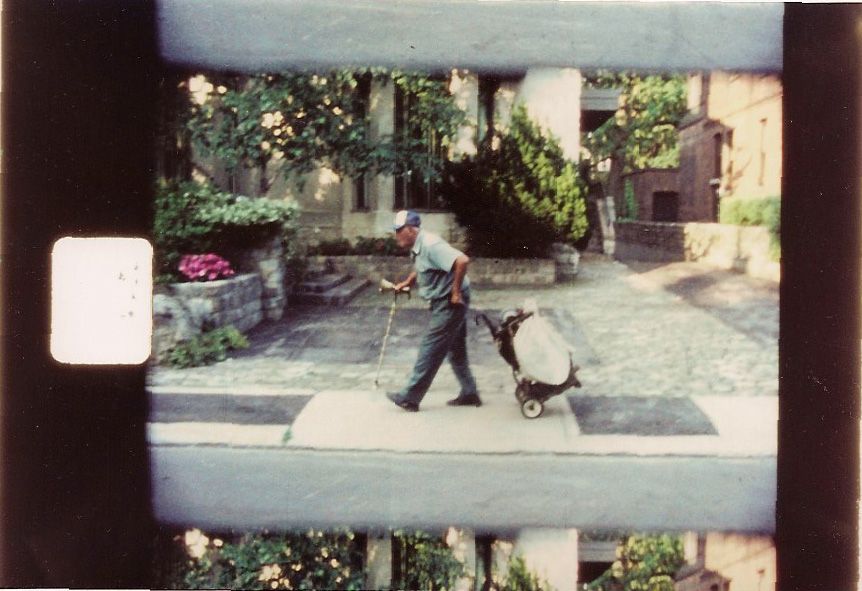
A Trip Around Toronto Harbour
John Porter | 1986 | Canada | Super 8 | 4 min
A Camera Dance created using time-lapse photography and pixelation. John and his friends Paul McGowan and Tom Urquhart rowing in a canoe and dancing with the camera, which focuses on them, attached to a long pole, from in front of the canoe. With the device running at one frame every two seconds, a roll of film captures the entire tour of the lakes among the group of islands in Toronto harbour, as well as a break for swimming. The title refers to the short film by Colin Brunton, A Trip Around Lake Ontario (1984).
(John Porter)
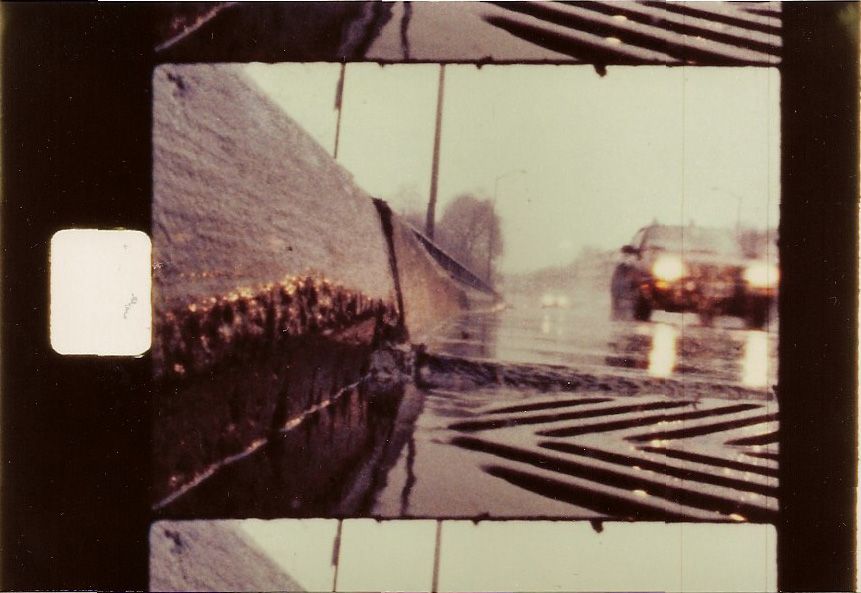
Martha’s Balloon Ride
John Porter | 1982 | Canada | Super 8 | 6 min
John mounted the camera at one frame per second on the outer edge of a balloon in which he was riding. The device was pointing downwards, visualising the ground passing by in the distance and the edge of the balloon’s passenger basket. It was filmed during two flights made a year apart, guided by Martha Davis, a friend of John’s, who was shooting her own Super 8 film from the basket.
(John Porter)
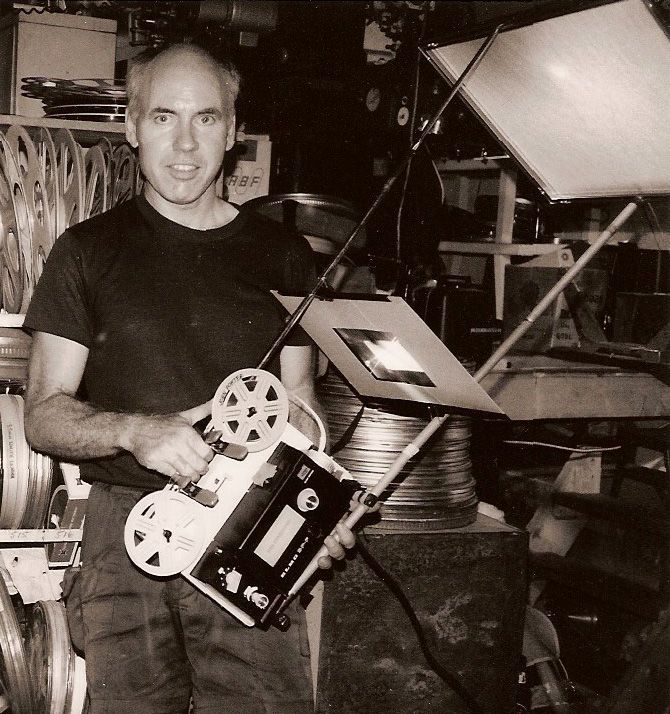
Pumpkin Parade
John Porter | 2018‒19 | Canada | Super 8 | 7 min
Close-up exposures of Halloween pumpkins glowing at night with candles in a “pumpkin parade” taking place in a park. An annual event held every 1st November, this was a unique event worldwide when it was first held in 2004 in Toronto’s Sorauren Avenue Park. Since then it has spread across the country and internationally.
(John Porter)
Variety Lights
John Porter | 1984 | Canada | Super 8 | 4 min
This is a continuation of an earlier film by John, Amusement Park (1978‒79). It documents various scenes in the centre of Toronto featuring lights that shine in the night. Just as in Amusement Park, all of them were recorded from sunset to nightfall, filming frame by frame with long exposures in each one. It began with one-second exposures and then their duration was gradually increased as daylight decreased and even after nightfall, to end up almost transforming the night scene into a confusing mass created by two-minute exposures in each frame.
(John Porter)
City Hall Fire
John Porter | 2005 | Canada | Super 8 | 4 min
The most recent Porter’s Condensed Ritual by John (time-lapse and pixelation). This is a performance with fireworks by the French Groupe F, held at Toronto’s modern City Hall during the city’s first WinterCity Festival. Film shot in a single take at one frame per two seconds, over two hours, with two-second exposures in each frame.
(John Porter)
Calendar Girl
John Porter | 1981‒88 | Canada | Super 8 | 4 min
John scratched and painted a Super 8 copy with synchronised sound of a black and white pop music film from the 1960s (Scopitone), which he made by pointing the camera at his old black and white television. John’s scratches and brushstrokes serve to exaggerate the sexism present in “music videos” of all generations, as well as to reflect upon it.
(John Porter)
Jewison, Superstar
John Porter | 1995 | Canada | Super 8 | 5 min
Jewison, Superstar is one of the funniest things I’ve ever seen, though I’m not entirely sure why. It involves of a promotional trailer shot on Super 8 for the film version of Andrew Lloyd Weber’s Jesus Christ Superstar by Norman Jewison. Porter replaces the original soundtrack with his own rendition of the title song, changing “Jesus Christ” to “Jewison”. His singing style has the same tone of distracted concentration as a child: it is rough yet charming, and he seems completely unaware of the roughness and charm. The voice simply cuts through the promotional trailer, invoking Jewison’s name instead of the Son of God’s. Jewison, Superstar could be interpreted as Porter mocking the persistent claim that Jewison’s commercial, vaguely liberal Hollywood product somehow represents what Canadian cinema is.
(Steve Reinke)
The Secret of the Lost Tunnel
John Porter | 1992 | Canada | Super 8 | 4 min
A Camera Dance created using time-lapse photography and pixelation. John gives a performance for the camera in an uncommon “narrative” film, edited in the camera itself. He plays the role of one of the Hardy boys who, naked, is carrying a torch in the dark and discovers a long and mysterious pink tunnel. As he struggles his way to the other side, picking up speed, he passes by advertisements posted on the walls and, in the end, emerges into a scene from Stanley Kubrick’s film 2001: A Space Odyssey (1968). John built the tunnel “set” in his apartment, varied the recording speeds to seemingly change the speed at which he was crawling, and later recorded his grunts onto the sound film. Inspired by a scene from the Woody Allen film Everything you always wanted to know about sex but were afraid to ask (1972). The title, and the title page of the film, are taken from a book about the Hardy Boys.
(John Porter)
Shovelling Snow
John Porter | 1992 | Canada | Super 8 | 4 min
A Camera Dance with synchronised sound. A one-take film, shot with no rehearsals by filmmaker Robert Kennedy, a friend of John’s. John acts for the camera, removing shovelfuls of snow at a fast, constant rate for three minutes (the duration of a roll of film recorded at normal speed). Himself, Robert, and the camera follow each other in a linear dance along the long sidewalk until they turn the corner onto John’s street. The film, with its rhythmic, squeaking sound, was conceived to be used by the group Fifth Column. It is a film that complements Blade Sharpener (1998), another Camera Dance with synchronised sound that was recorded in the summer on the same street and also intended for use by a music group.
(John Porter)
Blade Sharpener
John Porter | 1998 | Canada | Super 8 | 4 min
This is a Camera Dance with synchronised sound and no rehearsals, filmed in a single take at normal speed. John follows Mike Orlando, an elderly knife and blade sharpener, who pulls his whetstone on wheels down John’s quiet street in the summer, ringing a school bell to announce himself along the way. A “musical” designed to be used with a live band. The film complements Shovelling Snow (1998), another Camera Dance with synchronised sound that was recorded in the summer on the same street and also intended for use by a music group.
(John Porter)
In the Gutter
John Porter | 2000 | Canada | Super 8 | 4 min
Another Camera Dance in which itinerant views of the streets of Toronto are created, taken from below, from the gutter.
Edited in-camera and shot at nine frames per second with a homemade waterproof camera case attached to a stick.
(John Porter)
Picture Pitcher
John Porter | 1989 | Canada | Super 8 | 4 min
Baseball comedy and abstract painting. Pitcher Karen Fraser throws paintballs at the camera while catcher and filmmaker John Porter directs the game and cleans the frame between pitches.
(John Porter)
Shootout with Rebecca
John Porter | 1983 Canada | Performance in Super 8 | 4 min
A Camera Dance with synchronised sound, made in a single take with artist Rebecca Baird, a friend of John’s. Visual artist Rebecca Baird performs for the camera, playing an outlaw on one side of a shootout in the Wild West and firing a toy gun at the camera, in The Funnel Experimental Film Theatre art gallery (Toronto). The “set” is his installation in the Gallop Exit To gallery, consisting of simulations of sand on the ground and large cacti, both made of Rice Krispies cereal. The “Western movie” soundtrack of his installation also becomes part of this live-recorded sound film.
When it is projected, John performs live among the audience, playing a sheriff who is on the other side of the gunfight and he shoots at Rebecca, who appears on the screen, with a toy gun. They both shout at each other alternately, and the audience is on the side led by John.
(John Porter)
Revolving Restaurant
John Porter | 1981 Canada | Performance in Super 8 | 4 min
A Camera Dance made in a single take. This film is about a view from the window of the revolving restaurant at the top of Toronto’s CN Tower. When the film is projected, John acts in front of the screen, miming the role of a customer eating at a table by the window. However, because the film was shot at varying speeds, the restaurant spins at a dizzying pace, and John’s miming does the same.
(John Porter)
Animal in Motion
John Porter | 1980 Canada | Performance in Super 8 | 1 min
A Camera Dance with no camera, made with found footage. John performs live in front of the screen, running back and forth in sync with the film, which is all black except for a transparent frame that appears every five seconds. John runs across the middle of the screen while each transparent frame illuminates him for a mere fiftieth of a second, thus creating still images of him. Each of those frames is then replaced by a few pieces of found footage with sound in which a person shouts at the camera, and John, in turn, shouts at that person while continuing to run past at the right moment. The original version consisted of two short loops of 16 mm magnetic film in which the transparent frames and the found footage had been spliced together and which were shown several times each on different projectors. They were later copied from the screen onto a single reel of Super 8 sound film. The title refers to the photographic series Animal Locomotion by Eadweard Muybridge (1887), before cinema was invented.
Scanning 8
John Porter | 2016 Canada | Performance in Super 8 | 4 min
This is a version of Scanning 8 (see Programme 1) adapted to the space and the circumstances.
JOHN PORTER
SUPER 8 RADICAL
John Porter is from Toronto, Canada, and has been filming in Super 8 since 1968. Since then, he has produced more than 300 films and performances which in themselves are a manifesto of how Super 8 cinema, far from being a lesser cinema, stands in its own right within art thanks precisely to the characteristics of the device with which it is produced. Those who have written the history of Super 8 cinema (some of whom have been at this Mostra) have demonstrated how its supposed limitations are virtues when put at the service of certain sensibilities and imaginations. Born to a painter mother and an engineer father, Porter studied photography and film at Ryerson University in his native Toronto, where he found that these studies and the idea of cinema in general were dominated by industry and commerce. And Porter, forever a restless and rebellious spirit, realised that he had no interest in being a part of that. Super 8 was cheap, accessible, portable and, above all, there was no reason not to consider it a suitable format for the most ambitious creations as in one’s imagination. For Porter, this preference became activism, which has also led him to be an activist for alternative cinema in his city. Although producing films in Super 8 was cheaper than in other formats, there were not many exhibition spaces willing to set themselves up to show it. That need led him to become involved in collective organisations like The Funnel, a true home for experimental film, video art, and performance, plus all kinds of artistic expressions that existed between 1977 and 1989. Porter has always attended all the alternative film screenings in Toronto, and has also spent many years documenting all these events photographically, in addition to maintaining a calendar of these kinds of screenings on his website (www.super8porter.ca, an invaluable source of information about his life and work). Porter has also produced the celebrated Filmmaker’s Map of Toronto, a hand-drawn guide to all the places in Toronto that might be of interest to filmmakers (from galleries and exhibition venues to secondhand shops, post offices, bars, parks and more). He has also been or is involved in organisations like the Canadian Filmmakers Distribution Centre, Pleasure Dome, CineCycle and A Space. In other words, he has contributed significantly to building an alternative film ecosystem and documenting its history, while continuing to participate enthusiastically in this scene, which has more in common with the spirit of fanzines and the punk and DIY circuits (as a curious fact, Porter once showed his films at CBGB along with the band Fifth Column). Porter’s decision to actively belong to this free, rebellious community from all sides is undoubtedly a political stance.
But let us turn to the movies. One particularity in Porter’s cinema is how often formal invention is combined with a sense of humour. That combination of rigour and a playful spirit speaks to how Porter never loses sight of the fact that a screening of his films is also a channel of communication with the public. As Scott MacDonald points out in the interview he had with him in A Critical Cinema 3:
Whereas most Super 8 filmmakers have turned to this smaller format because economically it gives them the opportunity to make films as interesting as those they could make in 16 mm (or at least interesting enough), a few have gone further and produced films that would be more difficult to make, if not impossible, in 16 mm or 35 mm […]. While the Kuchar brothers transformed the limitations of 8 mm into a touching sense of humour—that is, into “limitations”—the Canadian John Porter has gone a step further: in some of his most memorable films, he has turned “limitations” into strengths.
Porter has worked for many years, especially on two film series. On one hand, there is the one he calls Condensed Rituals (whose title alludes to Warhol’s Campbell’s Soup Cans while at the same time being a bit of a parody of it), which is various activities and events filmed using time lapse. It is a time lapse that usually has a raison d’être, guided by ingenuity, in situations strategically chosen for that purpose. On the other hand, there is his series Camera Dances, which contains many films that would have been impossible to make in 16 mm or 35 mm at the time due to the camera’s mobility and the nooks and crannies it could reach. This series also includes actions that Porter “choreographs” for the camera, sometimes also using frame-by-frame filming. Several films from that series are famous —the so-called Cinefuge ones (of which we will see variations 4 and 5)—where we can find the gesture of hanging the camera from a rope and spinning it while filming, but in this case with intentions and aesthetics very different from those of Claudio Caldini in Gamelan (1981) or Un enano en el jardín (A dwarf in the garden, 1981). As he explains to Mike Hoolboom in an interview published on Hoolboom’s website:
I was inspired by the last scene in the spaghetti western The Good, the Bad and the Ugly by Sergio Leone where Eli Wallach runs around the camera which is at the centre of a circular cemetery, looking for a headstone. The camera keeps him in sharp focus while the headstones become a complete blur. It was so inspiring that this long, wild, chaotic shot could be contained in theatrical cinema.
Another interesting aspect of his work has to do with live interaction with the projection. This ranges from performances in which he seems to magically “enter” his films, like Revolving Restaurant (1981) and Animal in Motion (1980), up to his famous Scanning, in which he carries the projector on his shoulder as if it were a camera, following the movements recorded in the film being projected. The illusionism that cinema makes possible, both in recording it and in projecting it, is a subject that Porter uses in an intelligent, entertaining and formally dazzling way.
In the first session, Porter will show some of the films he considers the “calmer” ones in his filmography (though he clarifies that all of his films are fun), and in the second session (part of the Desbordamientos series in the Luis Seoane Foundation patio) we shall see the faster-paced, more sound-based films, and four of his performances.
Finally, it is also important to mention something pertaining to the exhibition of Porter’s films. Of course, they can only be viewed projected in their original format, Super 8. Only two of them have been digitised. Due to his production method, what one sees in each screening in most cases is the original camera footage. That is why Porter usually works the projector himself and cleans it conscientiously beforehand. In addition to this, many of his silent films feature live narration or commentary when they are being projected.
It is patently clear that Porter’s commitment to Super 8 is radical. It is a radicalism that has to do not only with total adherence to the format, but with what it means as a political action: believing that another world is possible.
Elena Duque