JOHN PORTER
PROGRAMME 1
Filmoteca de Galicia | Thursday June 4th | 7:30 pm | Free entry to all venues until full capacity. It will not be possible to enter the venues after the screening has started.
Cinefugue 4 & 5
John Porter | 1980‒81 | Canada | Super 8 | 5 min
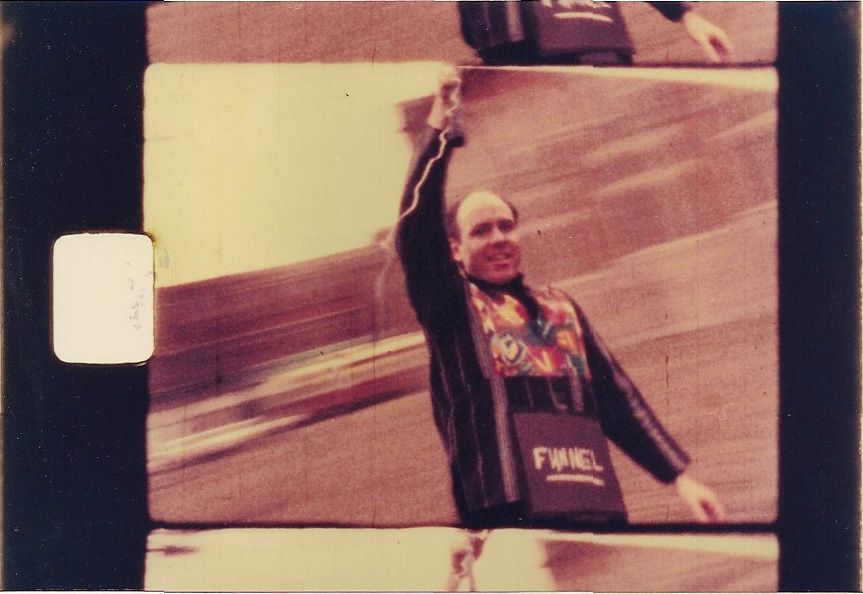
A series of Camera Dances in which the device is used like a centrifuge. John dances with the camera, swinging it around him hanging a long rope and always directing it towards himself, while the camera spins on the rope in its own way. Five versions in different locations. Created based on a scene in the movie Independent Filmmaking (1974), which John made in 16 mm during his student days, and inspired by a scene from Sergio Leone’s film The Good, the Bad and the Ugly (1966).
Cinefuge 4 & 5 is the only sound version. It begins with a synchronised sound version (number 5) recorded on the premises of Little Trinity Church as a television ad in which John tells the viewer about his upcoming show at The Funnel Experimental Film Theatre in Toronto. It concludes with version 4, in which a friend of John’s, the dancer Judith Miller, joins the dance taking place in Bickford Park. It was shot on silent film to which a soundtrack was later added in which an audio was recorded with sounds erased from version 5.
(John Porter)
Landscape
John Porter | 1977 | O Canada | Super 8 | 1 min
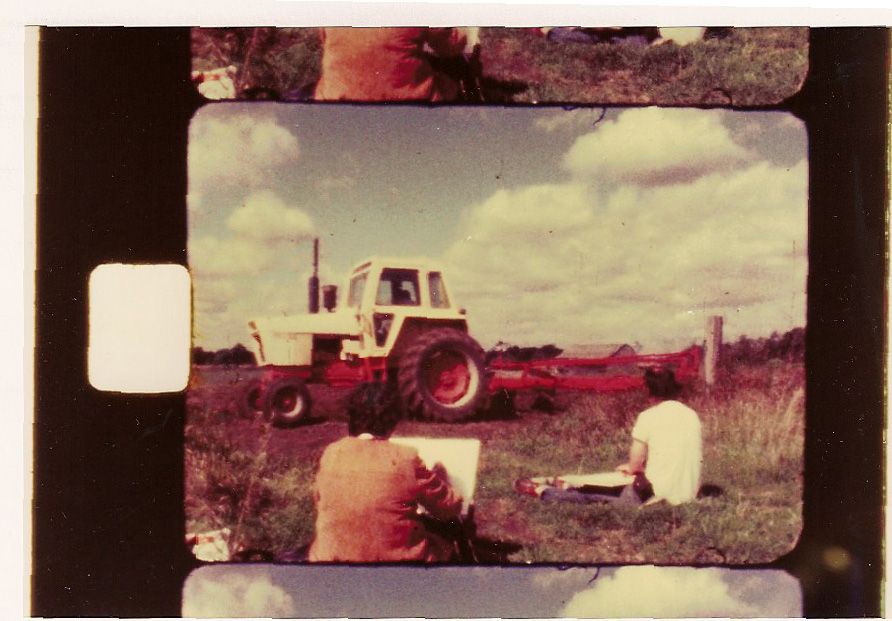
A Condensed Ritual by Porter (time-lapse and pixelation). John and his mother painting in the countryside, in summer. His mother has always painted and still does so at ninety years of age. When John and his sisters were small, she used to take them to paint in the countryside, and this was another one of those occasions, though it had been quite unusual since John’s pre-teen years before. The background scenery to the film is also the theme the painters are dealing with: a farmer’s brown field being ploughed by a red and white tractor; a grey silo, green trees and a blue sky with fluffy white clouds. As we reach the end, we get a glimpse of John’s finished painting; another unusual occurrence.
The film was shot in a single take at three seconds per frame over the course of an hour. Two contact prints were made in the early 1980s, but the original can still be exhibited. This is a film that complements Mother and Child, both made in the same year, about a mother and her son or daughter and emulating classical paintings.
(John Porter)
Mother and Child
John Porter | 1977 | Canada | Super 8 | 2 min
A Condensed Ritual by Porter (time-lapse and pixelation). Portrait of a seated Lis Guindon, a friend of John’s, holding her two-month-old daughter, Marie Claire, in her living room in Cabbagetown (Toronto). They later moved to Quebec and lost contact with John. Film shot in a single take at three seconds per frame over two hours, lit with a single table lamp and using three-second exposures in each frame. Mothers in particular find this film surprising and entertaining, and say that it evokes their own experiences. This is a film that complements Landscape, both made in the same year, about a mother and her son or daughter and emulating classical paintings.
(John Porter)
Santa Claus Parade
John Porter | 1976 | Canada | Super 8 | 5 min
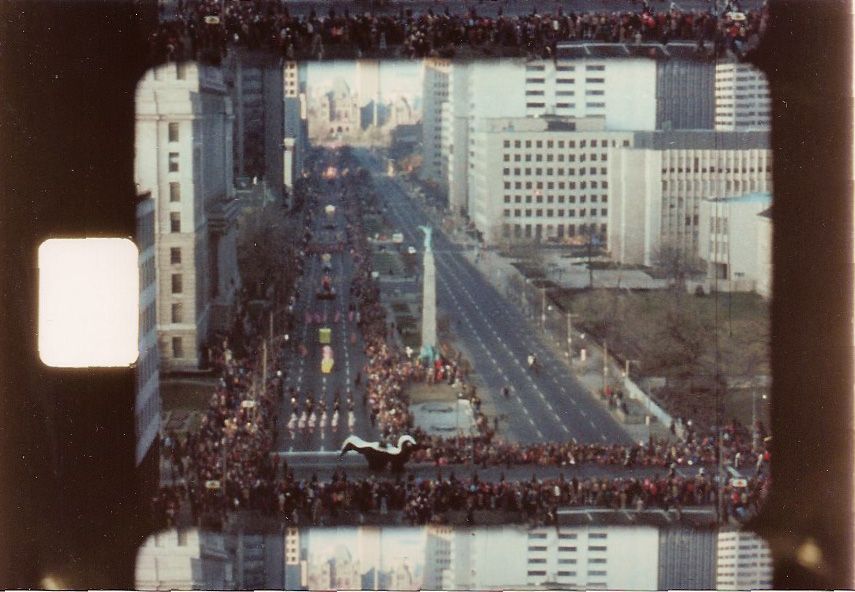
A Condensed Ritual by Porter (time-lapse and pixilation). The earliest of the films shown in typical retrospectives of John. Toronto’s grand Christmas parade, a historic annual celebration, seen from atop a tall building located at the end of the long, broad University Avenue, where the biggest crowds can also be seen gathering before the parade and dispersing afterwards. The building belonged to the Zurich Insurance Co., where John worked as a machine operator, and has now been knocked down. The parade’s route has also changed, so this perfect view of the event no longer exists. The film was shot in a single take, using two reels of film shot at one frame every four seconds over eight hours.
(John Porter)
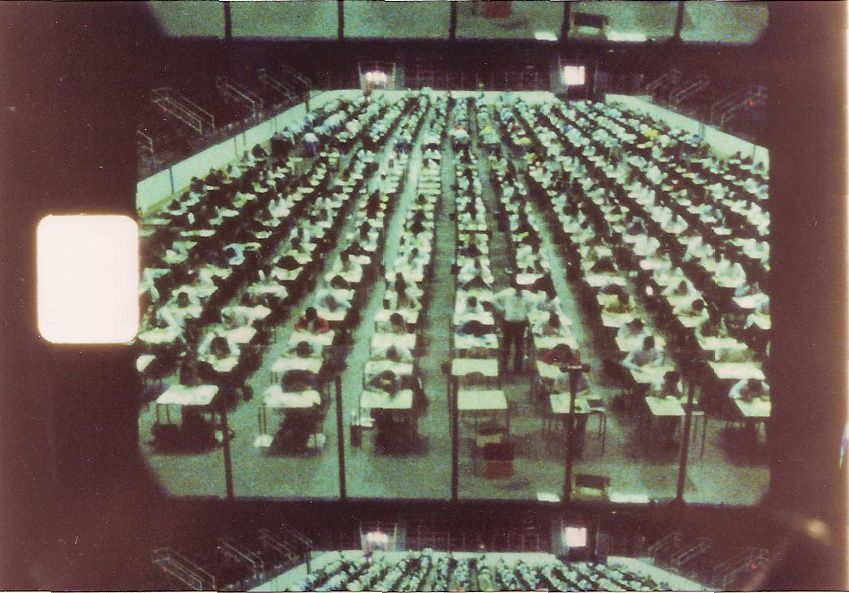
Exams
John Porter | 1982 | Canada | Super 8 | 4 min
A Condensed Ritual by Porter (time-lapse and pixelation). Hundreds of students taking an exam together at the University of Toronto’s historic Varsity Hockey Arena. A wide-angle view of the entire scene, from the top of the stands. The film was shot in a single take, using two reels of film shot at one frame every four seconds over eight hours.
(John Porter)
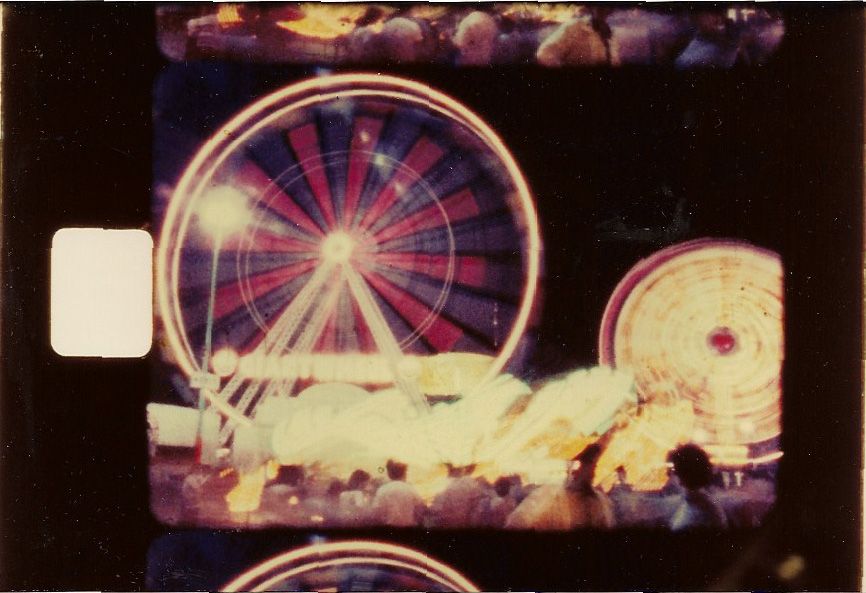
Amusement Park
John Porter | 1978-79 | Canada | Super 8 | 6 min
A Condensed Ritual by Porter (time-lapse and pixelation). Document of various attractions in the historic Canadian National Exhibition, which takes place every year in Toronto, filmed entirely at night, at one frame per second with one-second exposures. Two rolls of film recorded in two consecutive years were used, the first of which consists of close-ups of each attraction, edited in-camera. The second roll is a single long wide-angle shot of the entire “avenue” of attractions, seen from the top of the historic observation tower, which has since been torn down. This scene was filmed continuously over an eight-hour period that began before nightfall, with exposure times increasing as daylight decreased and even after nightfall, ultimately transforming the night scene into a blurry mass created by two-minute exposures per frame.
(John Porter)
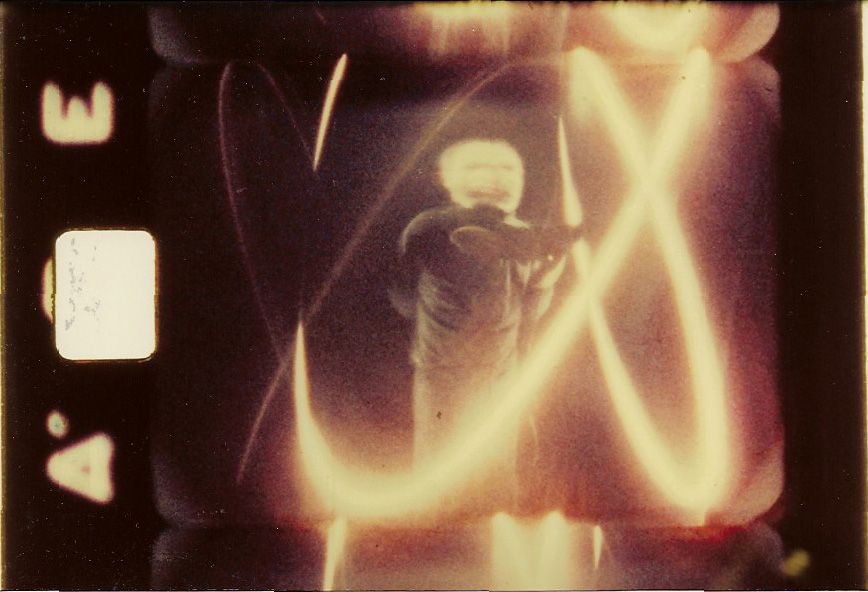
Firefly
John Porter | 1980 | Canadaá | Super 8 | 4 min
A Camera Dance Inspired by John’s film Amusement Park (1978‒79). John improvises a performance for the camera, making a bright point of light spin at the end of a long string around himself, following various paths, against a black background. The film was shot in a single take in an hour at one second per frame. With one-second exposures, the light beams multiply and become more complex as they refract in the lens. The lighting used was created with the help of Adam Swica, a friend of John’s.
(John Porter)
Swinging
John Porter | 1981 | Canada | Super 8 | 2 min
A Camera Dance and an artwork to accompany an earlier film by John, Angel Baby (1979).
We see John swinging on a swing he built in his studio. He shot the film by himself with the camera placed many feet away, so that while swinging, he continuously made the camera work one frame at a time, holding a remote control using a long cable. This enabled him to record each individual frame at the precise second that he passed by on the swing at a certain position within the arc of the swinging motion, thereby creating the illusion that he was frozen in the air, or flying in circles. In doing so dressed in white against a black background while using one-second exposures in each frame, he created the visual effect by which one perceives him as a series of brushstrokes.
This film is a single shot, filmed continuously over one hour.
(John Porter)
Lightsleeper
John Porter | 2010-11 | Canada | Super 8 | 4 min
John stars here in his own film, portraying a light-sleeping individual under a blanket of Christmas lights. It was filmed continuously over ten hours, with long exposures on each frame. One version was recorded in 2010, then four new versions were filmed simultaneously in 2011.
(John Porter)
Angel Baby
John Porter | 1979 | Canada | Super 8 | 2 min
A Camera Dance inspired by the 35 mm short film Pas de deux (1968) by Norman McLaren. John mimes for the camera, playing a clumsy baby angel learning to fly, a character inspired by another of the Charlie Brown strips by Charles M. Schulz, the bird Woodstock. An early, unusual “narrative” film by John, made with a “script” and a “teleprompter”.
(Alan Walker)
Dressed in white against a black background, John filmed at one frame per second and used one-second exposures to create an effect of flapping wings and brushstrokes.
In order to create the flying effect in his studio, he had to film with a mirror and interpret the story backwards (hence the teleprompter) and upside down. As a result, the film has to be shown from back to front, which in turn requires an adjustment of focus and frame lines differing from those of any film that has been shown just before or after. A film made in a single shot, filmed continuously for 45 minutes.
(John Porter)
Down on Me
John Porter | 1980-81 | Canada | Super 8 | 4 min
A Camera Dance created using time-lapse photography, pixelation, and exposures. John dances with the camera and lets himself get carried away by the device, which works at one frame per second and spins its way on the end of a fishing line while he makes it go up and down from rooftops and bridges. Throughout this time, the camera points from above at John, who is on the ground and raises his head to look back at the camera, and turns with it. “Camera hoisting” by Stephen Niblock, a friend of John’s.
Various locations were used, which were edited in-camera, and there were two recording sessions separated by an interval of one year; the first was outdoors and the second indoors (stairwells), recorded with exposures, with which occasional abstract vortices were created.
(John Porter)
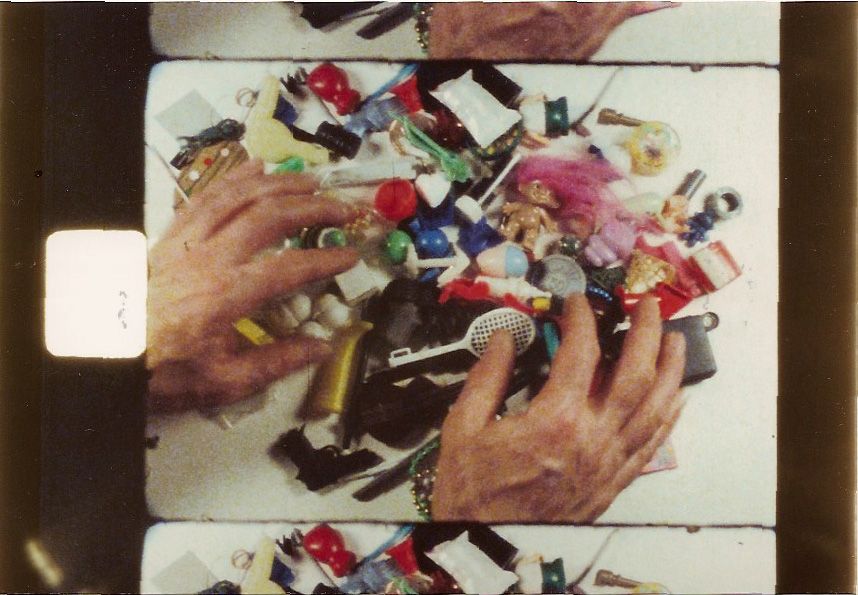
Toy Catalogue
John Porter | 1996 | Canada | Super 8 | 18 min
A growing series of sound films or else films with live narration that began in 1981. John documents part of his extensive collection of cheap, miniature plastic toys by pouring out sorted bags containing them onto a table under the camera, then scattering them to form compositions of colours and textures, paying special attention to certain toys among the masses of them. With a normal shooting speed and in-camera editing, it moves at a fast pace and the toys pile up, but John pushes them aside, and soon makes room for more in the middle. In a recording made on sound film after shooting, or in a live narration, he describes each scene and tells stories to the toys, and sometimes creates “sound effects” with plastic.
(John Porter)
Scanning 8
John Porter | 2016 | Canada | Performance in Super 8 | 4 min
Camera Dances in one take, with dances by an “enveloping Super 8” projector performed live. This is a continuing series of performances in silent film, in which John carries a Super 8 projector on his shoulder before the audience and moves the projected image around him, all over the walls and the ceiling, following the camera movements that appear in the film. Inspired by a projection by Anne B. Walters held at The Funnel Experimental Film Theatre Gallery (Toronto) in 1981.
Scanning 8 is a new version of Scanning 5 with the same movements and the same performer, David Anderson, but in a different location: Roundhouse Park on Bremner Boulevard in central Toronto.
(John Porter)
JOHN PORTER
SUPER 8 RADICAL
John Porter is from Toronto, Canada, and has been filming in Super 8 since 1968. Since then, he has produced more than 300 films and performances which in themselves are a manifesto of how Super 8 cinema, far from being a lesser cinema, stands in its own right within art thanks precisely to the characteristics of the device with which it is produced. Those who have written the history of Super 8 cinema (some of whom have been at this Mostra) have demonstrated how its supposed limitations are virtues when put at the service of certain sensibilities and imaginations. Born to a painter mother and an engineer father, Porter studied photography and film at Ryerson University in his native Toronto, where he found that these studies and the idea of cinema in general were dominated by industry and commerce. And Porter, forever a restless and rebellious spirit, realised that he had no interest in being a part of that. Super 8 was cheap, accessible, portable and, above all, there was no reason not to consider it a suitable format for the most ambitious creations as in one’s imagination. For Porter, this preference became activism, which has also led him to be an activist for alternative cinema in his city. Although producing films in Super 8 was cheaper than in other formats, there were not many exhibition spaces willing to set themselves up to show it. That need led him to become involved in collective organisations like The Funnel, a true home for experimental film, video art, and performance, plus all kinds of artistic expressions that existed between 1977 and 1989. Porter has always attended all the alternative film screenings in Toronto, and has also spent many years documenting all these events photographically, in addition to maintaining a calendar of these kinds of screenings on his website (www.super8porter.ca, an invaluable source of information about his life and work). Porter has also produced the celebrated Filmmaker’s Map of Toronto, a hand-drawn guide to all the places in Toronto that might be of interest to filmmakers (from galleries and exhibition venues to secondhand shops, post offices, bars, parks and more). He has also been or is involved in organisations like the Canadian Filmmakers Distribution Centre, Pleasure Dome, CineCycle and A Space. In other words, he has contributed significantly to building an alternative film ecosystem and documenting its history, while continuing to participate enthusiastically in this scene, which has more in common with the spirit of fanzines and the punk and DIY circuits (as a curious fact, Porter once showed his films at CBGB along with the band Fifth Column). Porter’s decision to actively belong to this free, rebellious community from all sides is undoubtedly a political stance.
But let us turn to the movies. One particularity in Porter’s cinema is how often formal invention is combined with a sense of humour. That combination of rigour and a playful spirit speaks to how Porter never loses sight of the fact that a screening of his films is also a channel of communication with the public. As Scott MacDonald points out in the interview he had with him in A Critical Cinema 3:
Whereas most Super 8 filmmakers have turned to this smaller format because economically it gives them the opportunity to make films as interesting as those they could make in 16 mm (or at least interesting enough), a few have gone further and produced films that would be more difficult to make, if not impossible, in 16 mm or 35 mm […]. While the Kuchar brothers transformed the limitations of 8 mm into a touching sense of humour—that is, into “limitations”—the Canadian John Porter has gone a step further: in some of his most memorable films, he has turned “limitations” into strengths.
Porter has worked for many years, especially on two film series. On one hand, there is the one he calls Condensed Rituals (whose title alludes to Warhol’s Campbell’s Soup Cans while at the same time being a bit of a parody of it), which is various activities and events filmed using time lapse. It is a time lapse that usually has a raison d’être, guided by ingenuity, in situations strategically chosen for that purpose. On the other hand, there is his series Camera Dances, which contains many films that would have been impossible to make in 16 mm or 35 mm at the time due to the camera’s mobility and the nooks and crannies it could reach. This series also includes actions that Porter “choreographs” for the camera, sometimes also using frame-by-frame filming. Several films from that series are famous —the so-called Cinefuge ones (of which we will see variations 4 and 5)—where we can find the gesture of hanging the camera from a rope and spinning it while filming, but in this case with intentions and aesthetics very different from those of Claudio Caldini in Gamelan (1981) or Un enano en el jardín (A dwarf in the garden, 1981). As he explains to Mike Hoolboom in an interview published on Hoolboom’s website:
I was inspired by the last scene in the spaghetti western The Good, the Bad and the Ugly by Sergio Leone where Eli Wallach runs around the camera which is at the centre of a circular cemetery, looking for a headstone. The camera keeps him in sharp focus while the headstones become a complete blur. It was so inspiring that this long, wild, chaotic shot could be contained in theatrical cinema.
Another interesting aspect of his work has to do with live interaction with the projection. This ranges from performances in which he seems to magically “enter” his films, like Revolving Restaurant (1981) and Animal in Motion (1980), up to his famous Scanning, in which he carries the projector on his shoulder as if it were a camera, following the movements recorded in the film being projected. The illusionism that cinema makes possible, both in recording it and in projecting it, is a subject that Porter uses in an intelligent, entertaining and formally dazzling way.
In the first session, Porter will show some of the films he considers the “calmer” ones in his filmography (though he clarifies that all of his films are fun), and in the second session (part of the Desbordamientos (Overflows) series in the Luis Seoane Foundation patio) we shall see the faster-paced, more sound-based films, and four of his performances.
Finally, it is also important to mention something pertaining to the exhibition of Porter’s films. Of course, they can only be viewed projected in their original format, Super 8. Only two of them have been digitised. Due to his production method, what one sees in each screening in most cases is the original camera footage. That is why Porter usually works the projector himself and cleans it conscientiously beforehand. In addition to this, many of his silent films feature live narration or commentary when they are being projected.
It is patently clear that Porter’s commitment to Super 8 is radical. It is a radicalism that has to do not only with total adherence to the format, but with what it means as a political action: believing that another world is possible.
Elena Duque