The Portuguese artist Beatriz Freire tells us about the ideas behind her work A Texture Map of Monnegre River, in which the projection is combined with the action of weaving on a live loom.
Where did your idea of transferring the codes from fabric to analogue film come from?
My medium is textiles, specifically weaving. I am a weaver. From there, all research, appropriation of other media and experimentation is based on using the language and/or technique of this textile art. My intention is to highlight the importance of weaving and give it the space it deserves alongside other arts historically recognised as such. In a way, I appropriate those other media to try to show the power, capability and flexibility inherent in weaving, not only as a practice, but also (and above all) as a language. The film aspect arose quite naturally, because I find many similarities and points of contact with textile work. The most obvious one is its material nature. Working with 16 mm celluloid, I realised that processes such as developing, drying the film, threading the projector, and splicing are curiously familiar to someone who works with textiles. When I started working with the Bolex and became acquainted with the work of Rose Lowder, another door opened up to explore that relationship between film and textiles, and the use of weaving notations as orders for filming. There is an idea that runs through all of my work: I believe that there is information, states and forms of existence that we cannot access via the ordinary use of our senses. Our body perceives what it can perceive, just as a cat’s body perceives the world in its own way. We inhabit the same reality, but we access it in different and limited ways. Nor do I believe that the traditional or classic use of a camera is enough to capture the invisible aspects of the world. I have a feeling that it is through the language of weaving that we can approach those other forms of perception. Weaving in itself contains a writing system: textile notations transmit information and arrange structures (they are quite similar to musical scores). Turning these ideas over in my mind, I wanted to test the possibility of using these textile codes as a shooting script, using the Bolex as if it were a loom, and then see what would happen: whether the rhythms of weaving can be transferred to film, to audiovisual media, and try to access that which remains invisible. The Portuguese writer Maria Gabriela Llansol spoke of the concept of fulgor (glow): she considered it to be not a passing illumination, but a form of everyday combat, a daily effort to find intensity and open up breaches in our usual perception of the world. I think my relationship with film and weaving approaches that idea. I am interested in using textile language and celluloid not only as tools for representation, but as devices capable of altering perception and accessing aspects that normally remain invisible. In that sense, A Texture Map of Monnegre River is an attempt to reach that glow.
How does this work/research relate to the Monnegre River?
I was selected for the Vapores residency by IDENSITAT, whose artistic research focused on the context of the Monnegre River, in Alicante. It was the first time I was able to materialise and test out my idea of shooting in 16 mm frame by frame using weaving codes as a shooting script. I named the project A Texture Map of Monnegre River, drawing inspiration from the work A Sound Map of the Hudson River by Annea Lockwood. My idea was to create a sensory map of the Monnegre River, focusing on its visible and invisible textures, not seeking a conventional mapping, but a poetic and material exploration of the river landscape. The aim was to generate a sensory archive which, by using various techniques (including film engaging with textiles), could build bridges between sound, image and matter, proposing new ways of interpreting and inhabiting the environment, de-colonising the senses and expanding the forms of perception.
Can you tell us about the introduction of your body and the loom into the live presentation of the work?
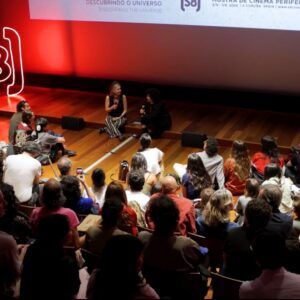
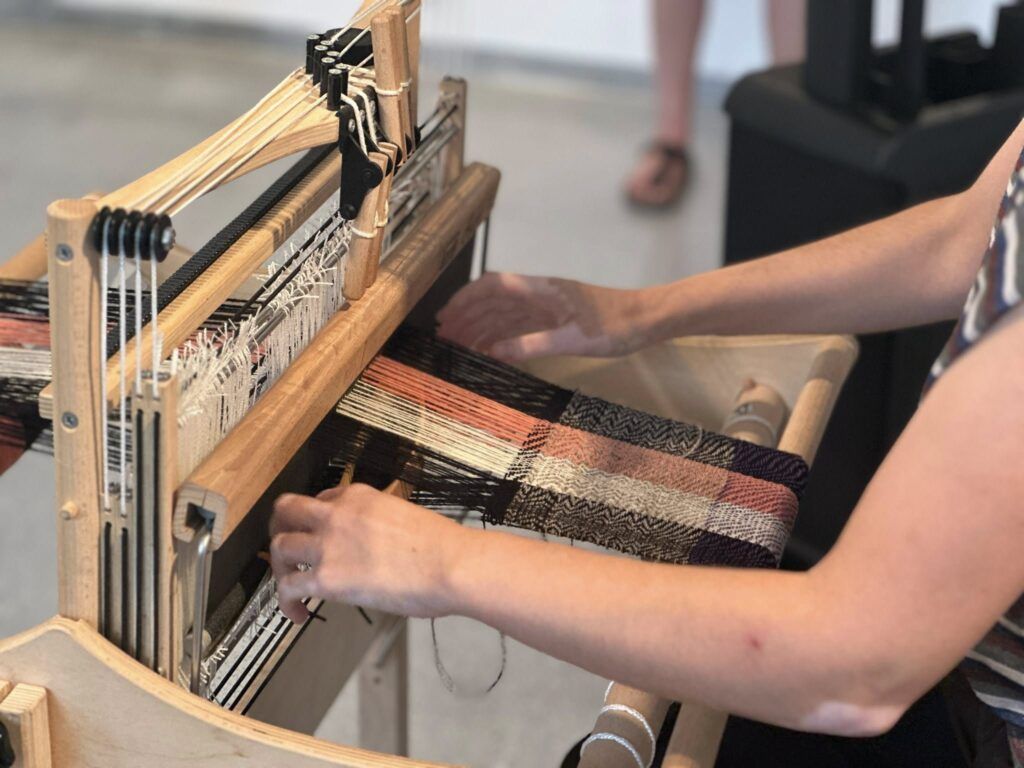
Weaving is about the machine, but above all the body; bodily sensation. Within my artistic work, where I try to expand the possibilities of textiles to the utmost, the idea of performing with a loom arose quite naturally. I am interested in people learning about weaving and becoming familiar with it. A handloom, and even more so a working handloom, is not something you often find, especially in contexts such as festivals, exhibitions, galleries or museums. That’s why, when the piece/project allows for it, I’m very interested in bringing the loom into the exhibition space and activating it live. I am still at a stage in my artistic journey where it is not always easy to get opportunities to access a suitable structure to develop and present your pieces in the ideal conditions that I imagine for the onlookers so that they can truly enter that state of perception or “glow” that I’m talking about. So, in a way, I take advantage of that limitation to shift the focus to the body, the gestures, and the presence of the live loom. Even though I am shy, the loom protects me from the gaze of others (at least that’s how I perceive it). The goal ends up becoming clear there: for people to be able come across a working loom in an unexpected context, outside the factory or workshop, and to perceive it from a different perspective.