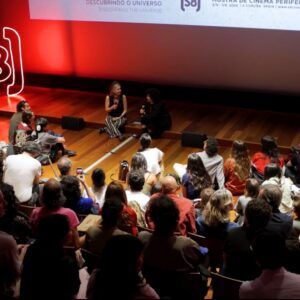
This year, we are dedicating a space to the work of the Kinothek Asta Nielsen film archive in Frankfurt, an institution that has been dedicated to preserving and disseminating the film work of women and gay people since 1999. Although the artworks they are bringing here are at home in the experimental cinema of the 80s and 90s in Germany, the institution’s founders Karola Gramann and Heide Schlümann decided to name it after a Danish silent film actress (whose work Schlüpmann specialises in): Asta Nielsen. Below, we present a profile of this essential figure.
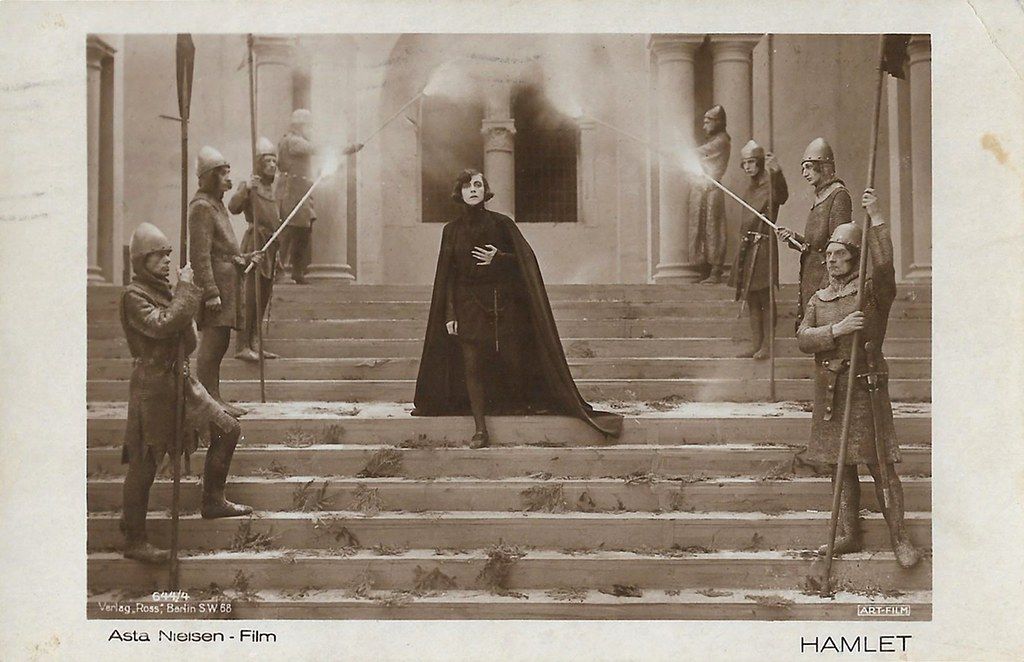
In the photo accompanying these lines, Asta Nielsen appears in character as Hamlet in one of her most famous film roles, in the movie Hamlet: A Drama of Vengeance, from 1921. It is a curious image that challenges gender roles, and that speaks to the class of person we are dealing with: Nielsen was one of the first movie superstars, and she was a star sui generis due to her way of existing and living, her interpretations of complex women, and her androgynous figure. Although long forgotten, today she is an icon of feminism, also claimed by the gay community.
Asta Nielsen was born in Denmark in 1881, the daughter of a blacksmith and a laundress. With these humble origins, Nielsen began studying theatre at the age of 18. Despite becoming a single mother in 1901, Nielsen finished her theatre studies and in that first decade of the 20th century she toured Norway and Sweden with the De Otte and Peter Fjelstrup companies. In 1910 she starred in her first (and scandalous) film, Afgrunden (The abyss), directed by her then husband (she would marry three times) Urban Gad in 1910, catapulting her to fame in Europe and America. In it, she played a music teacher consumed by passion, a role that laid the foundation for the archetype of femme fatal or vampire in a film packed with erotic content for the time. Shortly afterwards, Nielsen signed a contract with a production company in Germany, which is where she was to build her entire career. In Germany she founded the production company Film-Vertriebs-Gesellschaft together with the German Paul Davidson and Urban Gad, which owned all the European rights to her films. With an extremely lucrative contract for the time, Nielsen became the first international movie star, drawing huge crowds. In Germany they nicknamed her “Die Asta”, thus confirming her fame and her inimitable character. In 1921, Nielsen starred through her own film distributor Asta Films in the aforementioned Hamlet, based on a radical interpretation of Shakespeare’s work in which there is the suggestion that Hamlet was actually a woman disguised as a man.
Nielsen is known for her understated acting style, which distanced her from the gesticulations of silent stars, for her deep gaze and for her androgynous body. Capable of expressing the deepest pain and the most exalted passion, Nielsen played the roles of independent, complex women who ruled over their own destiny. Asta Nielsen acted in the roles of a young girl, an old woman, a prostitute, a proletarian, a suffragette, both a woman and a man, a gypsy and an Inuit, at all times showing the same naturalness in front of the camera. She became especially famous for her films about unrequited love, in which she played the woman who suffers, dies, or kills due to a lack of reciprocated love, as in Poor Jenny (Die Arme Jenny, 1912).
After acting in more than seventy films, with the arrival of sound (and also of her maturity), the actress left film for the theatre. After the rise of Nazism, she was offered her own studio by Joseph Goebbels. Nielsen later revealed that she was invited to tea with Adolf Hitler, who tried to convince her to return to film and explained the political power of her presence on the screen. Aware of the implications, Nielsen declined the offer and left Germany in 1936. She returned to Denmark, where she wrote articles on art and politics, and a two-volume autobiography.
In her later years, Nielsen devoted herself to collage and writing. She passed away in 1972 at the age of 89 after an accident she could not recover from, and was buried in a common grave following her last wish. She would never see a resurgence of interest in her work, which has been growing thanks to researchers and programmers since the 1990s. And of course she never got to see a film archive bearing her name in Frankfurt today.