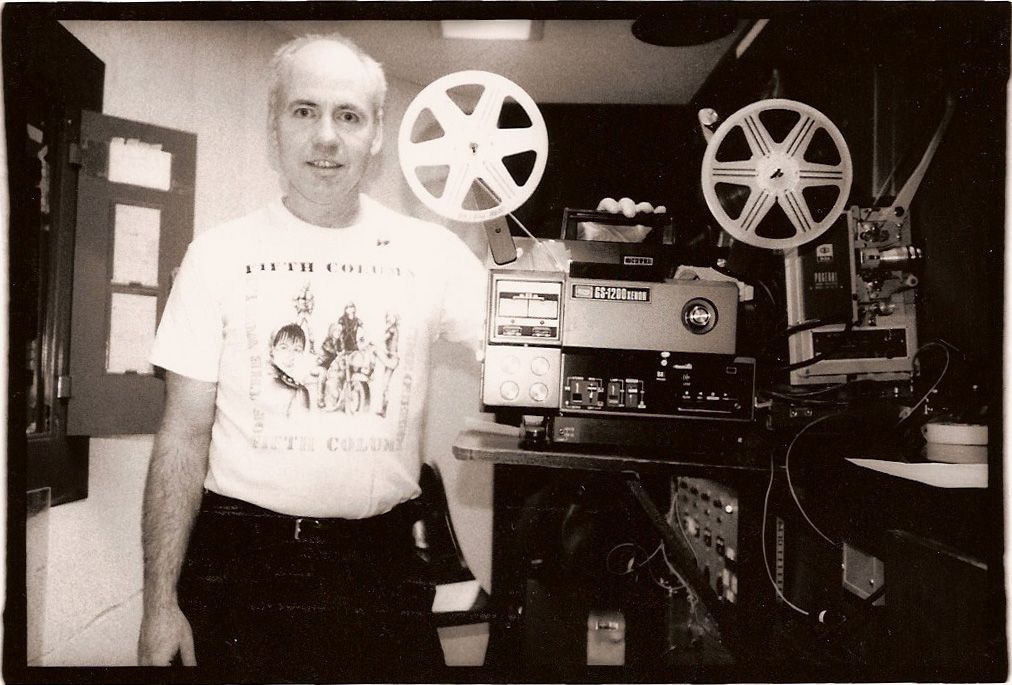
John Porter is an essential filmmaker in the history of experimental cinema in Super 8. It is no coincidence that he was one of the interviewees in the book series A Critical Cinema by Scott MacDonald, whose lineup of names is now a kind of star system of avant-garde cinema. Below, there is a fragment of that interview in which Porter explains how he made some of his main artworks, an unusual mix of experimental seriousness and play.
At what point did you begin to have the two series of films: the Condensed Rituals, the single-framing films; and the Camera Dances, the camera movement films?
I bought a Braun Nizo Super 8 camera from Ron Mann in 1976 (he’s a well-known documentarian now [Comic Book Confidential (1988) is Mann’s best-known film]). That camera allows you to open the shutter all the way all the time, and it has an automatic intervalometer, so you can slow the camera down as much as you like and get longer exposures on each frame. I realized that this was just what I needed to get blurred movement for my “dance” films, but it also meant speeding up the action, which made everything I shot with that camera funny, which I didn’t like. I wanted the freedom to make serious blurred films. In any case, it took me in another direction for a while, to the pixilated film: the idea of blurred visuals took a back seat to condensing time. At the beginning, I was just sort of playing around, making home movies of my friends. I wasn’t really inspired. There was little creativity to what I did. I did find the Santa Claus parade an interesting subject. I liked filming that crowd scene, not just the parade participants, but the audience along the route. I made that film over and over, starting in 1974. I was excited that I could record the whole Santa Claus Parade in just three minutes. For A Day at Home (1976), I just left the camera in a corner of the living room all day, to record the activity in the co-op house where I lived. I didn’t even need to be there! The Camera Dances are underway at this time, too. Cinefuge (1974) was the first Super 8 dance. The second part of Cycles (1976) ended up being a test for Angel Baby (1979). Before any of those was Pirouette (1972), a 16mm film inspired partly by Norman McLaren’s Pas de Deux (1967). I use exactly the same lighting as McLaren did. Pirouette influenced Angel Baby. After McLaren died, they showed a lot of his test films for Pas de Deux. I saw that he was doing exactly the same experiments I was doing in Cycles: trying to get blurred movement in pretty much the same way—dressing in white against a black background, walking back and forth and spinning his arms. He ended up with that staggered step-printing effect. Years later, just before his death, he was more seriously experimenting with blurred movement.
[…]
I’d guess many viewers find the Camera Dances your most interesting work. The 1974 version of Cinefuge is a remarkable film.
Yeah, I was pretty happy with that one.
But then you decided to redo that film, using different means. There are two different versions using wires. Cinefuge 3 (1977) is beautiful, color-wise, and very elaborate and complex. And then, still not satisfied, you came back to the idea and made the version you show most often: the advertisement for the show at The Funnel, which includes two versions shot at different times and spliced together. Among other things, the Cinefuge films (and some of the other Camera Dances) are unusually dynamic self-portraits. You’re always in the middle of the image, in focus, while the world flies through the frame at high speed. I can’t help but read the image as a metaphor for your sense of yourself and your life—trying to hold steady in the midst of fast-moving forces. The effect reminds me of Keaton, who creates a cinematic world where anything can move into or out of the frame.
That’s a good observation –myself steady in this whizzing world. I’d never thought about that in connection with Cinefuge but always in connection with the Condensed Rituals. After looking at all of the Condensed Rituals, I saw myself as this slow-moving person in a chaotic world. I was interested in self-portraiture in still photography, but not so much in film. The fact is that with this technique the filmmaker has to be in front of the camera. If somebody else were in the camera’s view, it would have been somebody else making the film I was feeling.
But the magic of it is that we realize it is indeed you creating the amazing image we’re seeing, as we see it. It’s a clear image, and yet, at least for a while, I’d guess, most viewers can’t figure out how you’re doing what you’re doing.
As far as the history of that idea goes, I often talk about being inspired by that scene in The Good, the Bad and the Ugly I mentioned earlier. But I was trying to choreograph the image, and that’s why I wasn’t satisfied with it initially: the first versions were so out of control.
The one on the tripod is very much in control.
Yes, but then I could only do a circular movement parallel to the ground, or a forward or backward walking movement. I wanted to have the camera moving on its own axis, and parallel to the ground in ways I could control. In one case, I went even further than using just wires. I asked a friend who made model balsa-wood airplanes to design and build wings for my camera. The plan was that the camera would be mounted between the wings inside a metal cylinder with wires I would control with a plunger. While the camera was spinning around me, I wanted it also to be able to spin head over heels inside the wings. I wanted to be able to control all these different movements and then choreograph a dance and shoot it. But the process was taking so long and involved so many factors that finally I ended up going back to the first Cinefuge, the one with the white rope, realizing that it was not only much easier to shoot that way, but that the very fact that the camera was out of control made for a more exciting film.
Michael Snow’s La Région Centrale (1971) used a device like the one you describe.
In a way, yes, but that was a big, complex device and created very different effects from what I wanted. I had the wings for a long time, though I never ended up using them. In general, I still wasn’t sure then that what I was doing was serious filmmaking, but I was almost obsessed with the idea of getting the camera to fly. I also made a film about building the wings: Wings (1977).
At the beginning of the 1977 version of Cinefuge, the camera spins around you while you remain right-side up; but later it spins around you and you spin on an axis around the lines, sometimes clockwise, sometimes counterclockwise.
I had a little stabilizer, a piece of cardboard like an airplane tail, taped to the side of the camera to keep it level. Removing it made the camera spin on its axis. The change in the spinning from clockwise to counterclockwise is a function of the increasing tension on the string; it was out of my control.
A lot of the Camera Dances move toward the abstract, a result of the way the camera spins in response to gravity. Some films (Down on Me, and Soarin’ [1981], for example) create circling, centered, mandala-shaped imagery that reminds me of Jordan Belson and the Whitney brothers. I wonder if you see a spiritual dimension in your acceptance of what the world gives the camera and what the camera gives the world?
No. I have friends who are into spiritual things and I appreciate spirituality, but I’m not interested in trying to understand it at all. I don’t consider it part of my work, unless it’s in a totally accidental, maybe subconscious way.
Often I get the sense that you see the camera and projector as toys, rather than as technological responsibilities you’re required to “live up to.”
I’d had that feeling about the camera as far back as 1974.
[…]
In recent years you’ve done some amazing performance pieces with the Super 8 projector. On one level, these pieces are quite simple, but they’re also magical; audiences find them astonishing.
I love panoramas. I’ve made a lot of them in still photography, and many of my condensed rituals are panoramic views. A couple of other filmmakers at The Funnel were working on similar ideas. Ross McLaren created a composite panorama on microfiche from the frames of a 16mm film. Anne Walters from Chicago came to The Funnel and hung a Super 8 projector from the ceiling by a rope so she could project her 360 degree panorama film around the room on the walls.
My first Scanning film in 1981 was just the flat image of the front of The Funnel building projected on the movie screen with a handheld projector. I’ve made five variations. The one I show now is the most recent and most complex, projecting on all the walls and the ceiling, and turning the projector upside down. I still plan to do a much longer, more complex version. This year I mounted a small screen onto the projector for an added dimension in the Scanning series.
Most of your recent work has involved one or another kind of performance. Why is that?
I’ve always been a performer. I was an actor before I started photography or filmmaking, but I hated memorizing lines. I’ve decided that film itself, being a theatrical medium, is a performance medium. I always consider the presentation of my films a performance. I like to be there in person to project the originals, and talk during them like live narration.
I know from talking with you that you have very strong feelings about what, in a general sense, film ought to be and what it oughtn’t be. In a sense, you’ve designed your life as a way of demonstrating how to function as a filmmaker. For you, what is filmmaking at its best? What is it at its worst?
Well, | would say that film shouldn’t be one way. Commercial films can be film at its best. But that’s an almost entirely different medium than mine: I’ve chosen film as a visual art. I would like to see the medium I’ve chosen as well-respected as any other type of film or art. I’ve always enjoyed fighting for the underdog, and I’ve come to enjoy this “battle” of trying to show that Super 8 and personal film is just as important as commercial film and should receive just as much public funding.