The Colombian artist Paola Guzmán Figueroa, who lives in Helsinki, tells us about her performance Trazos generacionales (Generational traits), in which she weaves an intimate story mingled with migratory lines and family ties between women.
In your performance, the symbolism of elements like water is very striking. Can you tell us about that?
I’m from Bogotá, a city at approximately 2,600 metres above sea level, surrounded by mountains, where bodies of water are not part of the everyday landscape. The nearest river has been polluted for many years, so during my childhood I had very little access to it. For many people in Bogotá, the sea is something distant, almost unknown.
My first encounter with the sea was in 1993, when my family and I migrated to Venezuela, to Margarita Island. It was an attempt at migration that didn’t turn out as we expected, and we returned to Colombia three months later due to the political situation at the time.
Years later, when I migrated to Helsinki at the age of 21, it was the first time I had lived away from home and also the first time I had lived so close to the sea, beside a port. Curiously, my brother had also migrated to Vigo, Spain, a port city closely linked to the ocean, while my sister lived in Maputo, Mozambique. We three siblings were separated by very different geographies but united by water.
That’s why water appears in my work not only as a visual or poetic element, but as a living memory. It has accompanied our family migrations from the beginning and, over time, it has become a symbol of connection, distance, displacement and belonging. Somehow, that which was once unknown to us ended up uniting us.
The image of four generations of women braiding each other’s hair is very beautiful. Can you tell us about the importance of that gesture, and about your work with hair on the celluloid strip?
The idea of migrating to a country so far away and different from Colombia has been a central part of this exploration. Distance has led me to look at my origins and family ties in a much more conscious way. There is also an important reflection on family and gender. In my family, women have always predominated, so my work also seeks to praise the role of my grandmother, who is now a great-grandmother, and at the same time to recognise the matriarchal presence and the importance of women within our family structure and also in society.
This performance and the act of braiding our hair emerged as an act of celebration: the birth of the fourth generation of women in my family and, at the same time, the family reunion after many years of separation. My Nanita, my grandmother, as the first generation; my mother, as the second; my sister and I, as the third; and Catalina, as the fourth generation. And it’s really nice to think about it now that I’m at this festival: Catalina was born in Galicia, in Vigo.
For me it was important that there should be a shared gesture between us, an activity carried out with our own hands, where we could build something together and leave a physical and symbolic mark between our bodies.
As regards hair, as I mentioned, I arrived in Finland at the age of 21 and, living away from home for the first time, I had an impulse to cut it drastically. It was almost a gesture of transformation, very similar to the change I was going through in my life when I moved to such a different country. I kept that hair without really knowing why. Some time later I decided to take it out and start experimenting with it as an artistic material.
Although hair is not a living object, for me its growth and persistence turn it into a bearer of memory, somewhere between the biological, the ritual and the symbolic. Over time I realised that my hair shared a language very close to that of celluloid: both are timelines, surfaces that keep traces, stories, presences and the memory of a time lived.
Turning to the presentation of the performance, the accumulation of layers of image also seems to evoke the layers of affection and knowledge that accumulate over generations. Can you tell us how the idea of multi-projector work came about and your process in that regard?
The use of the three projectors came about as a way to expand this story and its emotional dimension. For me, it’s almost as if the three projectors formed a single expanded body. The central projector contains the heart of the piece: the images most closely linked to this family story, which don’t necessarily follow a linear or traditional narrative order, but rather function more based on memory, which appears in a fragmented, intuitive, and emotional way.
The two side projectors, which work on a loop, for me are almost like two hands that uphold, accompany, and converse with that central image. Their visual layers expand meanings and allow images to encounter each other in unexpected ways.
I’m very interested in how, via overlays, new interpretations and emotions appear that perhaps a single image couldn’t hold. It’s almost as if those layers work like a skin or a shared memory, where feelings, memories, and connections between generations begin to surface in a more intuitive rather than rational way.
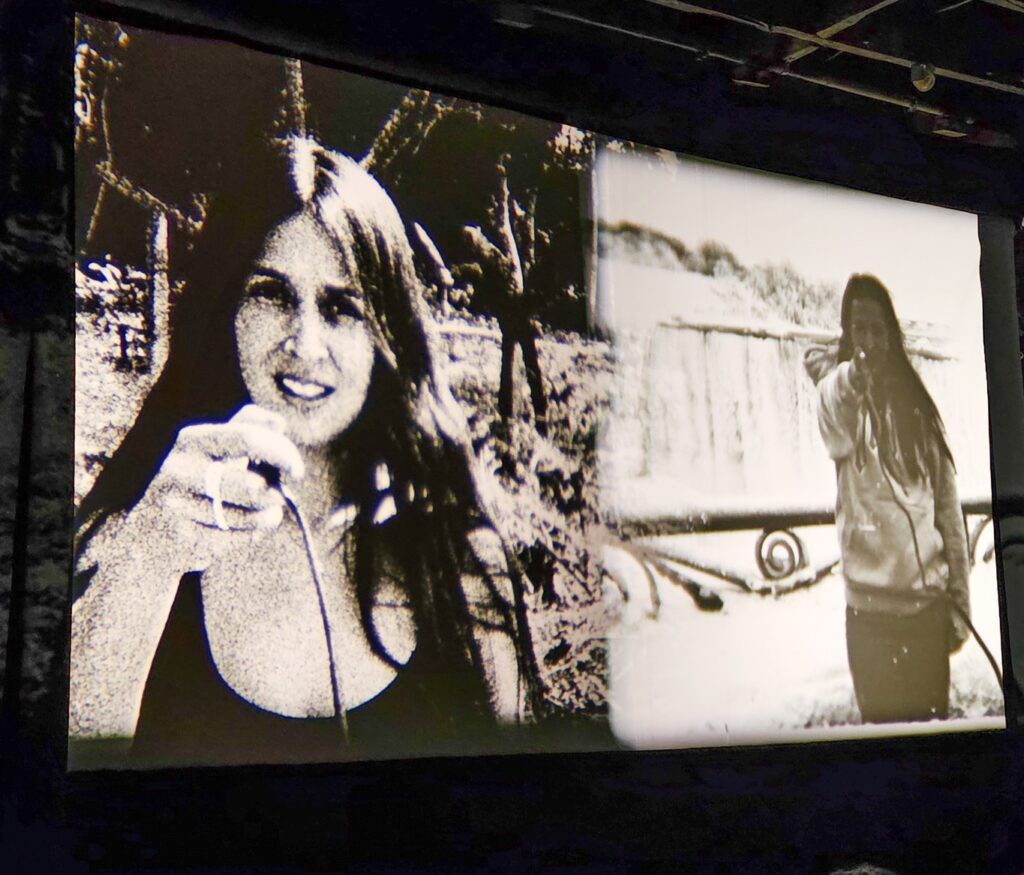
Finally, the image of the woman holding a strip of film that seems to be coming out of the camera/projector is very interesting, like a kind of link between reality and the filmed image. Can you tell us about that?
Yes; when I first filmed those images it was during a residency in Finland. I was alone and felt a very strong need for my own body to also be present within the image, but without abandoning the camera, as if I were somehow still tied to it. That connection was so strong that I also took it with me to the nearest lake and filmed myself entering the water.
That image symbolises precisely that union between my body, the created image, and the memory that remains captured within the material. There’s something about that physical connection that interests me a lot, because it makes that link visible between the one who remembers, the one who films, and the image itself. It’s almost like a thread, a bridge between the experience lived and the recording of it.
I also feel that it works like a kind of anchor to memory, to whatever I am trying to tell or evoke through the piece. Although it may seem like a narrative gesture, for me it ends up shifting towards a much more abstract place.