Morada aberta (Open dwelling) is a work that combines formats (digital video, analogue film, archive images, live interventions and a play of screens) to reassemble before our eyes the fragmented memory of the ancestral knowledge of the healers, devalued and silenced by history. In this interview, we discover the ideas and process behind this performance in the words of its creator, the Portuguese Tânia Dinis.
How did your interest in healers and all that ancestral knowledge begin?
My interest stems largely from my own experience and my family’s memories. I grew up in Seide São Miguel, in Baixo Minho, where it was very common to go to healers as part of a process of care and relationship with one’s body, illness and nature. My grandfather knows a great deal about medicinal plants, and these stories of witches, healing, and oral transmission have always been a part of my family’s imaginary. I myself have gone to healers a lot, and I continue to do so.
Based on that, I began to see these gestures not only as popular rituals, but as invisible forms of knowledge, linked to work, to the land, to listening and to collective experience. I’m interested in thinking about healing not only as a ritual, but also as a gesture of relationship and memory.
What was the research process like? What places did you visit, and what was it like working with the women you photographed?
The process started out from my personal memories and expanded to other areas of northern Portugal, especially the Alto and Baixo Minho, Galicia and the Atlantic coast. The research was carried out by living alongside these women and listening, accompanying their day-to-day lives, observing their gestures, their rhythms of work, their relationships with the land, the sea and with natural cycles.
My work always comes about closely linked to archives, to collecting images, objects, recordings and stories. In this case, the archive was also built up through conversations, testimonies, and intimate exchange. There’s a documentary side, but also a fictional and poetic one. I’m not seeking to portray these women in a linear way; I’m more interested in creating spaces for memory, presence and imagination based on what I gather.
You have a very interesting and ambitious stage production. Can you tell us about the process of shaping the performance? Where did the idea of multiple screens come from and what does it represent? Also about the mixture of formats, which is very much present in other works of yours.
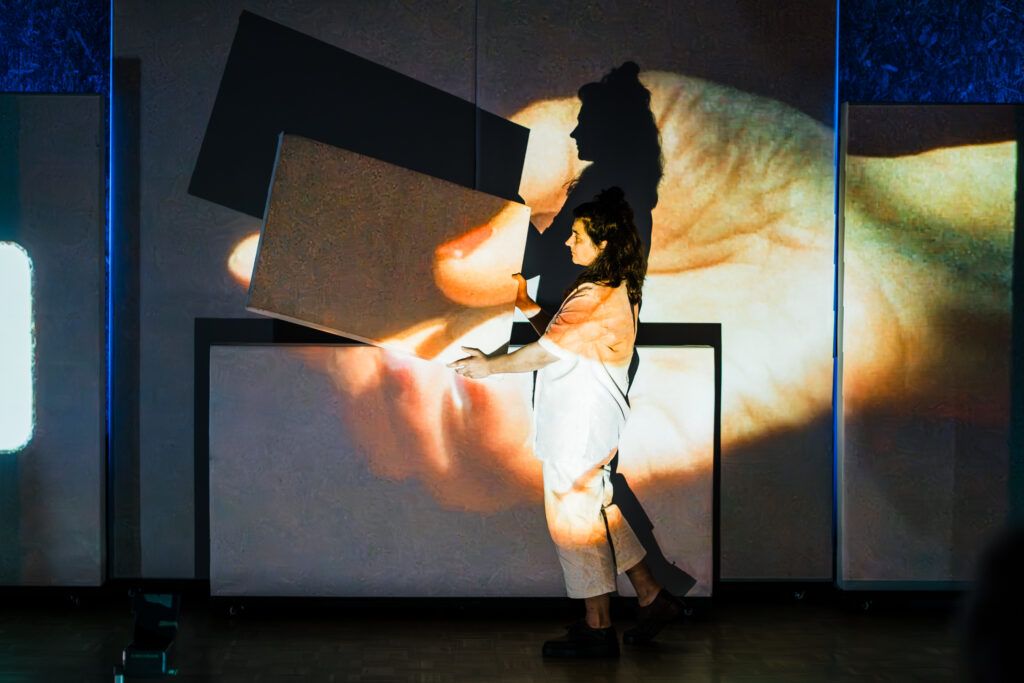
The staging arrangement largely arises from the idea of staging as a ritual. I consider myself a mediator of images and sounds. I work with images as living matter: I cut them out, rearrange them, project them onto transparent materials, onto my body, and onto other images. The multiple visual layers work like layers of memory, perception, and time.
I’m interested in the audience being able to construct their own images out of the fragmentation, overlay, and even the breaking up of those images. There’s an attempt to deconstruct one single interpretation and open up a space for a more sensory, intimate experience.
The multiple screens come from that desire to create different planes of presence, and to form a dialogue between projected and material images, past and present, archive and body. Mixing formats is also part of my work: I combine digital and analogue video, projections, photography, sound recorded on tape recorders, transparent materials, expanded cinema, and real-time image composition. I like that tension between documentary and fiction, between what seems to disappear and what still remains.
What does the inclusion of your own body on stage represent?
My body appears as another layer of image and memory. It’s not there merely as a performative presence, but as a body that activates the archive and creates relationships between the different materials.
I’m interested in thinking of the body as a place for transmission: a body that listens, that composes, that summons up ghosts, memories and absences. Often, the gesture becomes as important as the image itself. By putting my body on stage, I also take up a personal stance within the work: I’m not observing these stories from outside; I’m a part of them. There is an intimate and biographical link with the themes I work on, and the body ends up acting as a bridge between the present and that which remains in the collective and family memory.