What sparked first your interest in the cosmos? What are the readings/works of art that informed this interest?
I have no science background and I grew up in NYC where all I knew was the Moon, the Big Dipper and Orion’s Belt. Like many children, I was first obsessed with Egyptian and Greco-Roman mythologies, which was later so helpful with the constellations. My very first complete Super 8 film was called Blue Moon so I guess it’s been there all along, that desire to find affinities between bodily experiences and cosmic events.
But truthfully, I came to the cosmos after coming to film and photography—which of course is completely entangled with astronomy, in questions of perception, of optics and instruments, the phenomena of seeing and the act of observing, the eye and the sun. I felt that film was a very good medium to explore the subject of the cosmos since they were both described in time and space. An excellent book that informed me greatly about all of the above was Techniques of the Observer by Jonathan Crary (1988)—five stars! I have always been a voracious reader; I read widely and variously and have several shelves in my library of astronomy books at this point. Ancient origin stories from anywhere, the pre-Socratic natural philosophers, especially their favorite son Lucretius, who in De Rerum Natura gave us the cosmos as a chance event uninhabited by gods. Always poetry (opening my desktop folder full of cosmic poems by: Matthew Dover, Rene Char, John Wieners, William Carlos Williams, Adrienne Rich, Alice Notley, etc.), science fiction and science non-fiction (Velikovsky and Carl Sagan), and my first astronomy books Naked Eye Astronomy by Patrick Moore (1965) and Astronomy With an Opera Glass (1888), an absolutely charming and highly useful treasure —I learned amateur astronomy from those two books and my trusty binoculars. Shout-out to the children’s illustrated science textbook I found in the trash, written in Spanish, which gave me the title for my film. (I do sometimes wonder how being a child during the Apollo era was influential to my sense of the cosmic imaginary. Perhaps other cultural moments from childhood also include Kubrick’s 2001 and Pink Floyd’s space rock)
Could you tell us about the work process for Eclipse? What inspired the film, and how did you do it?
Eclipse is a Super 8 camera roll, filmed on Super 8 Kodachrome, and edited all in-camera. This lunar eclipse event is the same eclipse event we see in Observando El Cielo: I filmed with two cameras simultaneously (Bauer S8mm/Bolex 16mm) up on the roof of my apartment building in NYC. Some days later, a student approached me at The Museum School in Boston where I was a visiting a faculty. He was interested in experimenting with developing Kodachrome in black-and-white chemistry, which I had read about but never tried, and I agreed to make a workshop with him. On the appointed day, he forgot to bring his exposed roll of Kodachrome for the experiment, so we ended up using my eclipse roll, which was in my bag. I didn’t feel precious about the roll, because I wasn’t expecting much from it. The image that was produced by this process transformed the Moon into a vessel sailing through the dynamic chaos of outer space, which I believed was clearly in fact the actual reality. Amazing!
Technical note: The background colour is actually the clear orange masking of the film base and the strong scratch lines are from a) shaking and b) pulling the film out of the cartridge. Later, I used the optical printer to blow up the Super 8 to 16mm all at once.
Aristotle’s proof that the Earth was round in the 6th c. BC was to understand that the shadow we see in the lunar eclipse is our own. This sounds simple and it is, but it is also an instruction for embodied experience available to anyone, which can provide you with a feeling for the immersive three-dimensional space of our cosmic reality. Try it next time there’s a lunar eclipse and thank Aristotle.
Could you tell us about the foundational anecdote that made you begin Observando El Cielo? How long did it take you to make the film, where did you shoot it, how was the process of collecting the images and editing the film?
I began to film the stars because I wanted to know just what was going on out there. How to know reality for myself? One summer night, I was sleeping outside near the Muktikara lake in the countryside, and woke often during the night, startled by every snapping branch and fish jumping. Every time I opened my eyes, I noticed that the half-moon and constellations were all in different positions from the last time I woke. They were not moving across the scene in a linear progression —they seemed to be twisting, or swerving— I was shocked. I kept trying to combine the images in my mind’s eye, like intermittent animation stills, but it didn’t make sense. A film is happening in the sky and I can only see a few frames here and there. “What even is a sky?”, I thought. It’s a view, not a place. I had so many questions. I worked on the film over a decade, made some early tests with still photography to work out basic mathematical parameters —there are so many variables involved, with the world being the most variable (weather!), so it’s important to stay with a few constants, and the limitations of the technology are useful in this regard. I took any opportunities to leave the urban environment for clearer viewing and headspace / concentration. Other variables include film stocks, film speed and long exposures per frame, sometimes by hand and sometimes with a couple of different motors. After the initial tests to determine if I could successfully make an image of the stars on film, I just kept going —I am not the person who tests everything first and makes exposure charts, etc. before filming. The fun part is to see what the film material gives you and then figure out what’s going on later. That said, of course the basics of film and photography were fairly internalised for me at this point, so I could play around and enjoy myself with the process, which was sometimes a bit tedious —when you are making, say, 30-second exposures per frame at 24fps to get one second of film time; well, it is what it is. You have to slow down, and feel the time, or think or draw. All of this is part of forming the kino eye—the film’s essence is a meeting place for me, the machine, the material and the world which is in motion. As for motion: If I held the shutter open for more than approx. 30 seconds, the image blurred—because the planet that was holding up my tripod was/is moving. Oh, and in terms of composition, well, the aperture is small and the world is big. Sometimes I just pointed the business end of the camera up into the sky without even looking through the viewfinder, set it to infinity and go! While other times I attached myself to a particular star, or constellation, or something in the built-up environment for scale. So many single open frames and long cold nights, so many problems. I thought about a conversation I had with Peter Hutton once after our films played together, about how much it was possible for our eyes to see on looking into the dark, which he experienced often at night in the middle of the ocean on a ship. Sometimes when I was out there in the field, patiently looking out into the void while the camera clicked, I could feel myself literally perched on the outer edge of a planet slowly falling through space, with all of time spread out before my eyes forever. So scary! I would try to recognise my flicker of a self among everything that exists, a random miracle. “Ohhh, so THIS is reality,” I said out loud to no one. I considered all the film rolls in Observando as field recordings—celestial field recordings. Taking the term from the audio practice, recording in the world “on location” with an open perspective to the site, that has to do with listening—this as a practice for the recordist, separately from what is recorded. For me, this is also related to the camera roll as a distinct container for filmed time—not necessarily real time,
but as a finite recording it turns the time into an event. I learned about this from home movies and from filming with Super 8 cartridges; my true love and my internal clock! Three of the celestial field recordings that ended up in Observando were totally “perfect” camera rolls, no cuts necessary. And then there were rolls where only one shot was useful; oh, well. It took seven years to film seventeen rolls and the show time of the film is seventeen minutes, ha! I basically edited the entire film in about a year, on the Steenbeck with a splicer. Finding the form is always the task in the editing room, but especially with this film I had to remember my initial question—what is really going on out there?—and learned the shape of the film from the material.
Regarding Path of Totality, it is a performance about an eclipse with no photographic images. Can you tell us how this came to your mind, and how the performance is constructed?
The path or totality is the path of the Moon’s shadow on the Earth’s surface during a solar eclipse. In 2017, the width of this path was 70 miles/122 km, a narrow ribbon of shadow travelling at speeds up to 1000 mph /1600 kph. Path of Totality is named for the described path of the Moon’s shadow on the Earth’s surface during a solar eclipse. In August 2017, “The Great American Eclipse”, the width of this path was only about 70 miles wide, a narrow ribbon of moonshadow travelling over 1000 mph across numerous states. One must be in the path of totality in order to view the total eclipse of the Sun—I travelled to be inside of it, like millions of other people.
In Annie Dillard’s essay Total Eclipse (1982), she writes about her experience in the 1979 path of totality, experiencing the total solar eclipse near her home in the Pacific Northwest. This poetic essay was circulated widely in the summer of 2017, and I read it again as a meditation, hoping for some signs of physical magic to anticipate. I wondered what my questions might be after this event. I was struck by one particular line where she was attempting to describe the alienated strangeness of it all, saying “We got the light wrong”. That intrigued me. Is it that the light produced by the event was so particular that it could not be remembered? Or that we could not interpret the uncanny nature of the eclipse light and would hence forget? Could photography prevent this forgetting, as it promises? Afterwards, the internet was flooded with everyone’s images of the solar eclipse, of course, the joy of cosmic solidarity. But from the best astrophotographers to the crappiest home movies, none of the images were even remotely related to the experience of light and space that I lived through, those few minutes where the source of light was spread out around us like a 360-degree sunset, together on this round planet which holds us upright among the stars. I thought about Hito Steyerl’s “Too much world!”, and I felt weighed down by the proliferation of so many unhelpful images. I put my cameras away.
The sound component of the piece was created by Eric Baus, Phil Cordelli and Oren Silverman, who I called “the band of poets”. They were making music together and were the catalysts for the initial performance when Eric invited me to contribute visuals for an upcoming gig at Georgia, a gallery started by Sommer Browning in her garage in Denver, Colorado. He gleefully told me we are calling ourselves Path of Totality, as the cherry on top of a hype-filled summer of eclipse fever. We performed as a band of four-three sound and one visual performer. The projections were created with that balance in mind, as a series of gestures that were part of an improvised abstract sound composition. All art aspires to music, said Walter Pater, and this turned the key to unlocking my image problem and gave me a method for working.
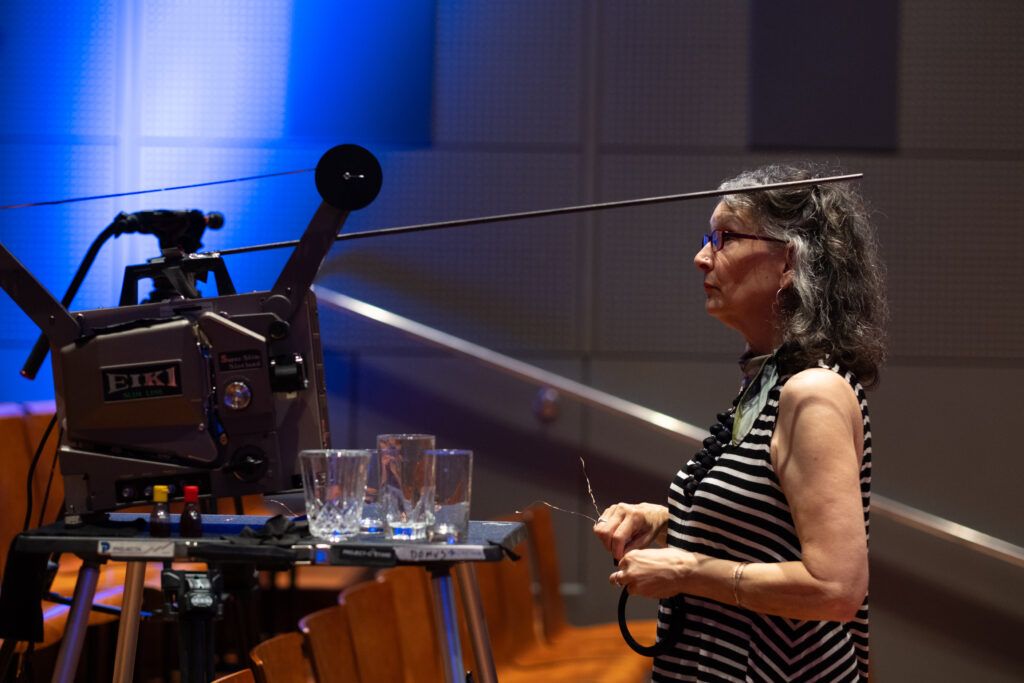
This work contains no images of any celestial events whatsoever, yet is precipitated by my experience of the total solar eclipse in August 2017. The piece consists of one 16mm film loop with handmade punch holes running on a 16mm projector providing a rhythm of intermittency, while I maneuver simple objects both concrete and transparent, in front of the projection lens, moving the shadow images out into the space and beyond a frame. Visual concepts of light latency, peripheral vision, and the cosmic imagination are activated through the use of everyday objects and “invented” lenses made from glasses of water, as one might use a torch and an orange to demonstrate the relationship between the sun and the earth. The art of projection is posited as essentially mimetic of the cosmos—light source, screen, and reflection.