This Thursday Pablo Agma presents his film performance Niño monaguillo y sus pecados (Altar boy and his sins) as part of the Desbordamientos evening dedicated to Sinais. Here, the Galician artist (who has visited us before with Hombre de palo (Stick man)) opens up a door for us to his creative process.
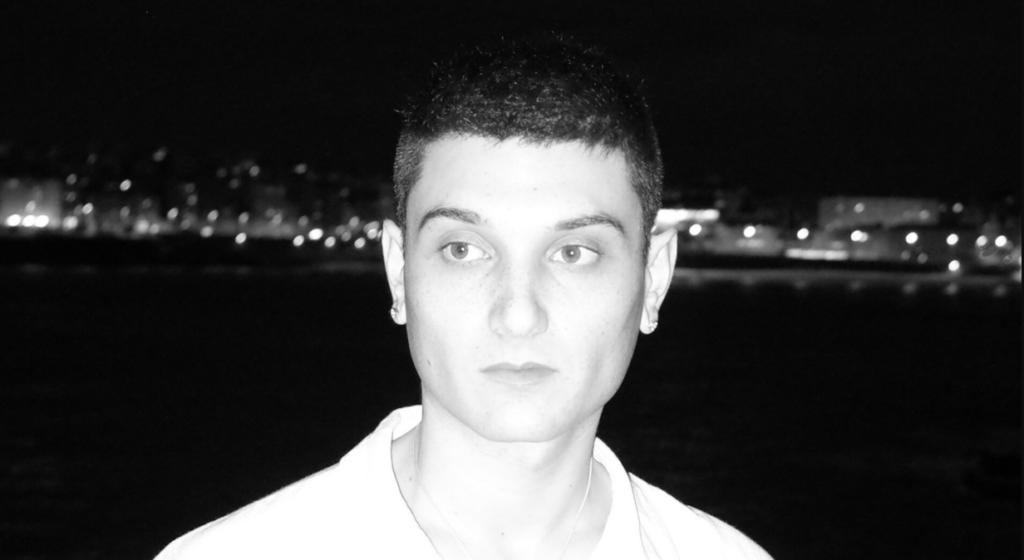
Can you tell us about Catholic imagery, and about the figure of the altar boy? Where does this interest of yours come from; what is it that attracts you to that world?
It comes from various spheres and places, the clearest being life itself. I grew up in that context. I would go every Sunday to mass with my grandfather and I often helped out with the Eucharist for the priest as an altar boy. It’s part of my personal and visual education. I’m also interested because it’s a tremendously theatrical world, with its characters, costumes, rituals, sounds… there’s a very strong aspect of staging.
From an iconographic perspective, I’m also very interested in how Catholic art has related to the body and eroticism. There’s a very powerful contradiction between a culture that represses or judges desire and at the same time has an imagery full of exposed bodies, naked Christs, saints in ecstasy, sometimes deliberately eroticised as so often happens with Saint Sebastian… I remember also starting to discover my sexuality through those images and how wrong it felt.
The piece is very personal, even though it’s built upon a certain autofiction. It recalls
that part of my life, and also a time when judging homosexuality was…very normalised (I myself was infected by that). Equally, I fondly remember that time and a certain enjoyment in going to church and helping the priest. I think the performance portrays that complex contradiction between tenderness and fear, guilt and enjoyment, and I articulate all of that through the altar boy character, who now helps out with the projectors that summon up the image.
The piece is divided into sorts of chapters. Can you tell us about its structure?
It’s arranged according to the confessional process of the Catholic religion, but it twists it. I was interested in using that skeleton, but taking it to an ambiguous ending, seeking above all a visual liberation and a celebratory feeling.
The core of the piece is the second act, Algarabia (Uproar), which takes its name from the accumulation of voices one can hear off-screen that at times prevent each other from being heard. Among this group of voices, one predominates: a kind of confession. I like to think that a mental side to the film is activated here, that the image is generated not only on the screen, but also in the viewer’s mind.
The first act, Los santos patrones (The patron saints) is the prelude to confession: an examination of conscience, a look at the past, at a familiar place…It’s filmed in the church I used to go when I was little in Vigo. It begins as a leisurely description of the space but transitions into a cathartic flicker observing those religious iconographies packed with eroticism.
The third act, Act of satisfaction, takes its title from the final part of the confessional process. It’s a less common way of referring to penance, and I chose it because of its ambiguous tone. The image of the burning doll might suggest punishment, but by intervening in the projection with glass, the fire gets abstracted and transformed into something else—a light show, almost a party.
The performance combines filmed images with live interventions. Can you tell us about the decision to turn it into a performance and the formal aspect of the piece?
Niño monaguillo was conceived rather impulsively, more than three years ago,
starting off with small gestures: first the text of Algarabía appeared, then the statue of
a headless little angel I found in a Madrid cemetery. Then I began experimenting by scratching the film’s emulsion… At some point I brought all those materials together, which were permeated by common obsessions and by a period when I was very much involved in therapeutic processes that made me look towards the past and wonder who I was and why.
At first I conceived of the film as a work of installed cinema, but while testing out the manipulations live I became interested in the structural similarity between liturgy and the act of projecting. Both set up a sensory experience in a space and time separate from the everyday. They have the power to attract, directing the attention of a group, and they make an image appear before them. The relationship between the screen and the altar also came to make sense. In both cases there is a frontal nature, an elevated image, and a series of preparations necessary for the latter to manifest itself.
There is an inherent ritualistic quality to cinema, very similar to a ceremonial experience, and I have attempted to enhance that side through images, narrative structure and the live staging itself. When I premiered the performance in La Casa Encendida, there was a confessional sustaining the loops of Algarabía and I had the live accompaniment of Le Chatelier, the composer of the film’s music, who learned to play the organ for the occasion. When I showed it at the Filmkoop in Vienna, I gave an introduction in which shadows were projected of how I was loading and threading the celluloid in the projector. For me, this film doesn’t just happen on the screen. It is completed in the space, involving the audience, and it also happens in the interaction with the devices and scenic elements. Working on it live was the way to take the idea to the end.